
 Opportunity score: 52 out of 100 — Worth exploring
In Writing
One clear written answer after a crash, instead of three agents disagreeing.
Published · Last assessed · Methodology v5.1 · How ideas are researched and assessed
Problem in brief
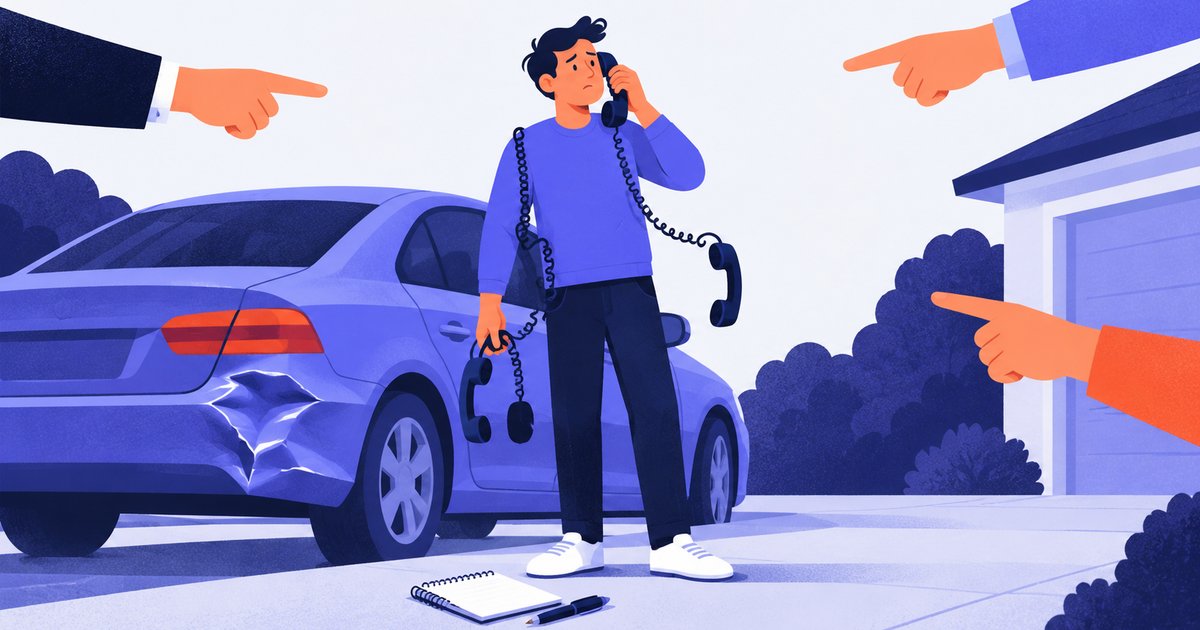
After a small crash, a driver has days to decide whether to file a claim, what to tell the other party's insurer, and whether to accept a waived deductible or pay out of pocket. The advice they get is verbal, contradictory and unrecorded — one poster got three different answers from three agents, and the one who agreed with them could not note it down because he wasn't their agent. With a repair estimate near or above the car's value, the stakes feel real but no one at the insurer will commit a situation-specific answer to writing. People cope by reading generic free guides, calling more agents, or posting the whole story on Reddit for strangers to judge.
- Who has this problem
- US personal auto policyholders in the first days after a minor collision, deciding whether to file, what to share, and whether to take a deductible waiver or cash settlement
- How they cope today
- Calling multiple agents to compare answers and posting on Reddit to crowdsource guidance and rates
- What it costs them
- Decisions on claims handling and major purchases stall amid uncertainty, with no documented or trustworthy answer
- Opportunity explored
- In Writing, described below
The problem in detail
After a small accident, drivers get conflicting, unrecorded advice. One poster 'spoke to 3 insurance agents this morning and was advised by 2 to not share my insurance info and by 1 to do so' — and the one who said to share 'was not able to note this down' because he wasn't their agent. Another has a 2002 Camry bought for $4,000, no police report because damage 'looked like under 2000 dollars', a collision shop estimate 'over 3,000', and a choice between a waived deductible or paying out of pocket, with nobody willing to say which is right. The real gap isn't price benchmarking — it's that no one at the insurer will put a situation-specific answer in writing, so decisions stall and people post the whole story on Reddit for strangers to judge.
Proposed product
A paid written second opinion on a specific auto-claim decision, produced by a former claims adjuster. The driver uploads their declarations page, photos, any repair estimate and a short description of what happened, and within 24 hours gets a two-page memo: what their own policy language actually says about this situation, what the likely outcomes are (file vs pay out of pocket, accept the deductible waiver vs not, total-loss risk given the car's value versus the estimate), what to say and not say to the other party's insurer, and the exact questions to put to their adjuster in email so the answer is on the record. The memo includes a ready-to-send email template requesting written confirmation from the insurer, plus state-specific notes (e.g. no police report, minor-damage thresholds). Flat $59 per situation; a $39 follow-up when the insurer responds.
Why now
This is mostly a long-standing problem rather than a new one: drivers have always been given verbal, unrecorded advice after a minor crash. The only supporting shift in the evidence is that claim handling now accounts for 65.2% of closed insurance complaints in 2024 NAIC data (delays 22.2%, unsatisfactory settlements 12.2%), and that the closest paid substitute, JustAnswer, has drawn subscription-billing complaints including an FTC allegation about recurring enrolment after a nominal join fee — leaving room for a flat, one-off written deliverable. No evidence shows a new consumer habit of paying for this.
Smallest useful version
Recruit two retired or part-time auto claims adjusters, take intake through a simple form, and hand-write the first 25 memos from a fixed template. Promote by answering the same questions publicly in auto-insurance and accident subreddits and offering a written version. Success: 25 paid memos in six weeks and at least a third of buyers saying they changed or confirmed a decision because of it.
Potential ways to charge
- Free triage checklist — £0: a one-page 'what to ask before you file' sheet and email template, given away in return for an email address (loss-leader; no price in evidence)
- Single situation memo — £45 one-off (anchored to the proposed $59 flat fee, far below the $250–$325/hour public adjuster rates in evidence 6): two-page memo plus insurer email template
- Follow-up review — £30 one-off (anchored to the proposed $39 follow-up): read the insurer's written reply and draft the next email
- Escalation pack — £115 one-off (anchored below Auto Claim Consultants' $250 total-loss appraisal in evidence 4): memo plus a structured complaint letter and state DOI referral pack where the offer looks unfair
Routes to early customers
- Answering real posts in auto-insurance, accident and personal-finance subreddits — the exact place the recorded complaints appeared — and offering a written version
- Body shops and independent repairers, who see the estimate-versus-car-value squeeze first and have no stake in the claim decision
- Google search ads on 'should I file a claim or pay out of pocket' style queries, tested small because free guides from NerdWallet, Bankrate and Credit Karma already own that result
- Independent insurance brokers who want to hand clients a neutral second opinion they themselves will not put in writing
Main risks
- Willingness to pay is untested: evidence 8 found no job posting or demand datapoint for consumer-paid per-situation claim memos, and the buyer's demonstrated reflex is to collect three free agent opinions
- Free substitutes cap the price: generic guides from NerdWallet, Bankrate and Credit Karma answer 'file or pay out of pocket' at $0 and state DOI hotlines give claims guidance free (evidence 5, 7)
- JustAnswer already sells a paid, written, situation-specific expert answer in as little as 6 minutes versus the proposed 24 hours; the differentiators are structure, a named adjuster and no subscription, not access (evidence 3)
- One-shot purchase with no repeat or referral loop, so acquisition cost must be recovered on a single sale against search terms dominated by well-funded free publishers
- Regulatory exposure: paid situation-specific advice on filing, disclosure and settlement edges toward state-licensed public adjusting or legal advice; the evidence does not establish whether unlicensed pre-claim advisory for a fee is permitted
Questions to test first
- Put up a $59 pre-sale page against Reddit and search traffic for the exact query and count paid conversions, not email signups
- Buy five JustAnswer insurance answers on these exact scenarios and check whether they already read the policy, script the adjuster questions and leave a record
- Check public-adjuster licensing statutes in two or three states on whether paid, unlicensed pre-claim advisory to a policyholder is lawful
- Run a small Google Ads test on 'should I file a claim' queries and compute cost per paid memo against the ticket price
- Test $59 against $149 on identical traffic to see whether conversion is price-driven or value-driven
Evidence and sources
The sources this assessment is based on. Evidence level: Indicative, counted from these sources as described in how ideas are assessed. Findings are what a source shows; anything the research only inferred is marked as an inference.
Research findings
Contextvendor pricing page
Shows: competitor
Auto Claim Consultants sells flat-fee auto-claim expert reports: Total Loss Appraisals $250, Diminished Value Claims $275, explicitly 'no percentage of recovery' versus attorneys' 33%. It proves flat-fee per-situation auto claim expertise is a real sold product at ~4x the proposed $59, but it covers valuation disputes after a claim is open (total loss, diminished value), not the pre-filing decision, policy-language reading, deductible-waiver choice or scripting of questions to the adjuster.
Supportsconsumer review aggregator / regulator complaint record
Shows: competitor
Gap evidence against the closest general substitute, JustAnswer: ConsumerAffairs reviews list cons including 'Monthly membership can be pricey' and 'No lower fee for single question', with reviewers reporting surprise charges (one says a $5 offer billed $33). The BBB profile notes an FTC complaint alleging consumers were enrolled in recurring monthly subscriptions after a nominal join fee. This supports a positioning gap for a flat, one-off, no-subscription $59 written deliverable rather than a chat subscription.
Supports · inferencestate insurance regulator consumer guide
Shows: regulatory-context
Massachusetts DOI's consumer claims guide states insurers must provide a written letter explaining a denial and the specific policy language relied on, and advises consumers to 'seek professional advice' on settlement fairness. Written obligations attach after a decision, not to pre-filing coaching — consistent with the candidate's core claim that no one will commit a situation-specific pre-claim answer to writing. The regulator's advice to seek professional help is also free-substitute competition (state DOI hotlines).
Supportsindustry analysis of NAIC complaint data
Shows: market-complaint-data
ValuePenguin's analysis of NAIC data states that in 2024 claim handling accounted for 65.2% of closed insurance complaints, with delays (22.2%) and unsatisfactory settlements/offers (12.2%) the largest sub-categories. Independent of Reddit, this shows claim-handling confusion and stalled/unsatisfying outcomes are the dominant consumer pain point in insurance — the zone the memo targets. It does not isolate the pre-filing 'should I file / accept a deductible waiver' decision.
Contextfree consumer guidance content
Shows: competitor
Free generic guides from NerdWallet, Bankrate and Credit Karma already answer 'should I file a claim or pay out of pocket' and discuss deductibles, rate impact and when not to report; these are what the driver finds first in search and cost $0. They are generic rather than read against the user's own declarations page, estimate and state rules, and none produce a written record the insurer can be held to — the stated differentiator — but they cap willingness to pay for information-only output.
Supportsindustry pricing articles
Shows: pricing-benchmark
Public adjuster fee articles report hourly rates around $250–$325 for experienced adjusters, flat fees of roughly $500–$2,000 for simple claims, and contingency fees of 10–20% of settlement (louislawgroup.com). On a $3,000 repair on a $4,000 car, every existing policyholder-side expert option is economically impossible, which is a plausible reason the minor-collision segment goes unserved and posts on Reddit instead; a $59 flat memo sits far below the existing floor.
Weakens the casevendor pricing/review page
Shows: competitor
JustAnswer — on-demand paid Q&A with verified experts across 150+ categories including insurance; priced as a $5–$25 join fee plus $28–$125/month membership, answers in as few as 6 minutes. For this customer it already delivers a paid, written, situation-specific expert opinion on 'should I file / what should I tell the other insurer', which is the core of the proposed product; it does not produce a structured two-page policy-language memo, email templates or state-specific notes, and the expert is anonymous rather than a named former adjuster.
Where the problem was reported
Public posts in which people described this problem, grouped into one problem before research began.
- Living in Washington moving to Nevada, need to insure homes in both states · r/Insurance · 3 November 2026
- TD GlobalExcel Claim Denial · r/Insurance · 20 October 2026
- How much insurance should I get for my 2014 car? · r/Insurance · 20 October 2026
- Questions about what to do after an accident. · r/Insurance · 13 October 2026
- Michigan Tesla insurance · r/Insurance · 10 October 2026
- Follow up post with new information · r/Insurance · 4 October 2026
- Norcal Tesla Insurance · r/Insurance · 3 October 2026
Looked for, not found
- No real job/freelance posting or search-volume datapoint was found showing people paying hand-done, per-situation written second opinions on minor auto-claim decisions. Upwork results surfaced only adjacent roles (Xactimate estimators, coverage-analysis and claims-support freelancers, independent adjusters paid fee-per-claim by carriers), i.e. demand from insurers and attorneys rather than from policyholders. Whether consumer willingness-to-pay exists at $59 is therefore untested.
This is a researched opportunity, not a guarantee of commercial success. The evidence level and sources show how much is known; the risks and questions to test show what is not.
Related product opportunities
Chosen for a shared category, customer or problem.
Individuals and households
Plate BackWhen a US driver switches auto insurers, the new carrier is meant to report the policy electronically to the state DMV.
Individuals and households
Rate CheckA driver with a car insurance quote in hand has no straightforward way to find out whether the number is reasonable for someone with their vehicle, coverage and ZIP code.
Individuals and households
Job ProofHomeowners who have just paid an HVAC company for an installation, major repair or service visit often have no way to judge whether the work was actually done properly.
Individuals and households
Claim ClockWhen a car insurance repair or a boiler or home-emergency claim stalls, the insurer or its approved repairer controls the facts that decide it: whether the damage counts as wear, whether a part is really on back order, when an engineer will actually attend.
Individuals and households
Mail VaultPeople who have used one email provider for twenty years or more have no easy way to search, archive or migrate their full mail history.
More individuals and households ideas →
Finding and judging opportunities like this one
The method behind this idea, written up as guides you can apply to your own.
- How to find product ideas worth building
Find product ideas by starting from problems people describe in their own work, not from brainstorms. A practical method with real examples, from the research behind Daily Product Idea.
- How to evaluate a product idea before you build it
Evaluate a product idea by scoring the evidence rather than your enthusiasm: six dimensions, a written reason for each score, the assumptions it rests on and the cheapest test to run first.
- How to validate a product idea before building it
Validate a product idea with evidence of what customers do, not what they say: find the assumption that would kill it, run the cheapest test that can fail, and set the pass mark first.
- Problem Signals Report, autumn 2026
Six weeks of community posts, counted: where real problems surface, how people work around them, and why most product ideas are easy to build but hard to differentiate.
£49One buyer only
Claim